Memo
ARCH
Arch builds an exoskeleton for the mind, making humans superhuman in an AI world.
AI keeps getting better, human brains don’t. This gap is going to define the next decade.
Most people will respond the obvious way: outsource more thinking. Ask the model. Let it write. Let it decide. Let it remember.
AI assistants are a wheelchair for thinking. A wheelchair is incredible when you need it. But if you ride it everywhere when you don’t have to, your legs atrophy. Same thing here. If you stop using your memory, you forget more. If you stop making choices, you get worse at choosing.
And in a world where AI can create almost anything, the most valuable thing isn’t output. It’s decision, taste, judgment. What you choose to do next. When your default move becomes “I’ll just ask the AI,” you’re not getting smarter. You’re handing off the part that makes you you.
A lot of AI products are quietly training people to be passengers, we’re not building that future. The core belief is simple: Compute should extend the human mind, not replace it.
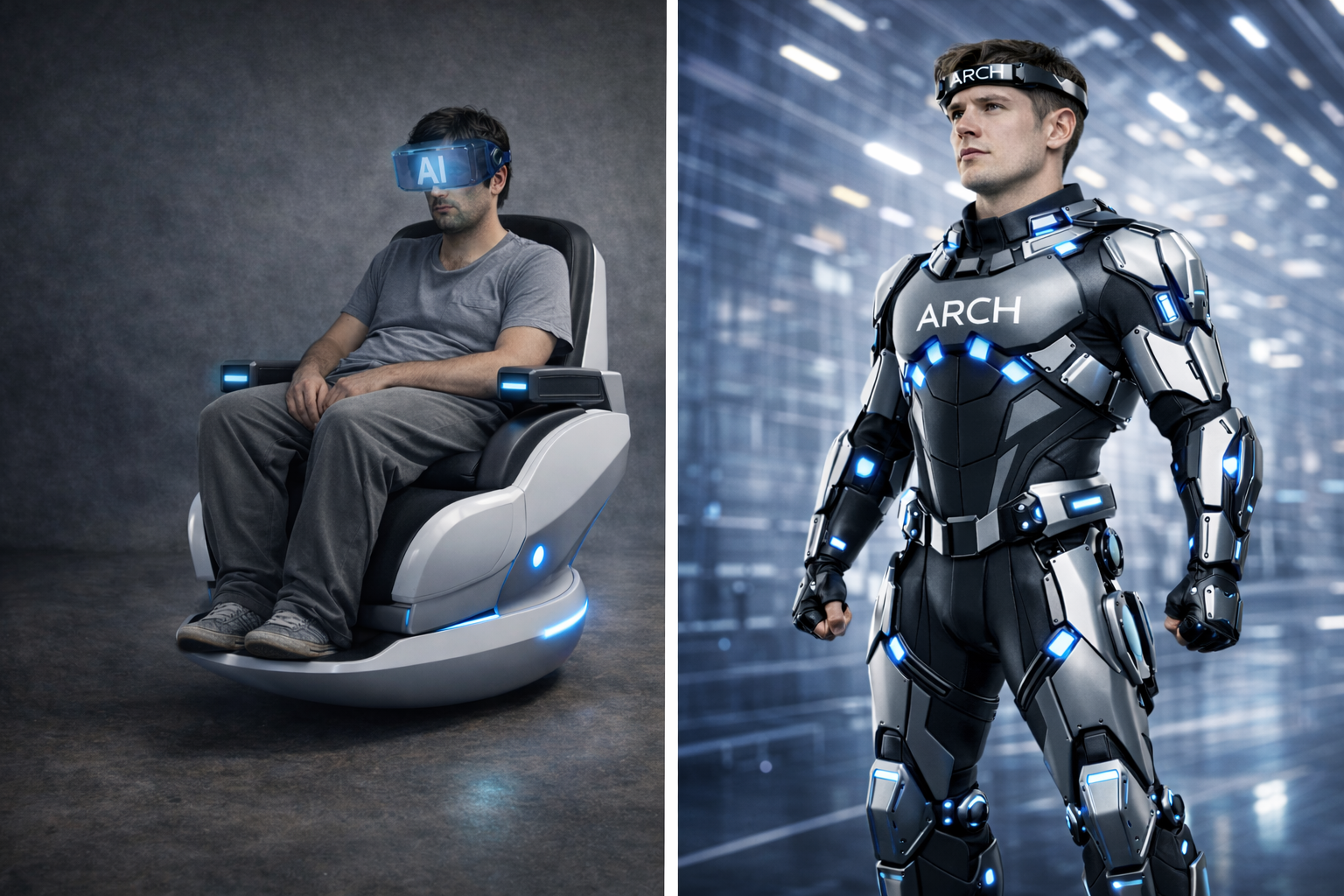
The Real Problem
The bottleneck isn’t intelligence, it’s the interface.
We have more computation than ever, but we access it through a straw:
- screens
- typing
- speech
To use it, you have to stop what you’re doing, pull out a device, and translate your thoughts into prompts, that’s not mind extension that’s using a tool.
And it breaks exactly when you want compute most: in motion, in conversation, in the middle of a task, in the real world.
You want to research something while walking? You can’t. You want the right memory in the moment? You don’t have it. You want real answers fast, without pulling out a laptop and going heads-down? too slow, too clunky.
If we want humans to stay competitive, we need a new interface. Higher bandwidth. Always with you. Built for real life.
Not a place you go to use computation, computation as something that lives with you.

What We’re Building
Arch is a full stack: Crown (interface) + MeOS (OS layer) + apps.
Crown
A crown is a headpiece worn on the head as a symbol of power
Crown is a wearable that sits at the edge of your hairline.
It captures real-world context (including audio/video) and neural signals. Crown speaks to you through private audio only you can hear.
Crown is with you in the world, in every moment that matters.
The point is adding compute to your brains, so you can do things like:
-
01 Research on the go Think a question while you’re walking and hear information back.
-
02 Pull memory on demand Get the right detail at the exact moment it changes the outcome.
-
03 Carry a live scratchpad in your head Have names, numbers, constraints, next steps, all captured and called up without opening a screen.
-
04 Run compute inside your thinking Do the math, compare options, check a claim, without stopping to type.
We’re keeping some details quiet for now, but the direction is clear: increase the minds compute.
MeOS
On top of Crown, we’re building MeOS.
MeOS is the layer that holds your world data:
- what you see and hear
- what’s happening
- what you’re trying to do
- what you’re about to do next.
It turns your real life into something computation can actually work with—without you having to narrate your life into a text box.
Apps
Apps sit on top of that and deliver augmentation in real time:
- memory (recall when it matters)
- research (answers while you’re moving)
- learning (in context, not in a course)
- decision support (clarity when the stakes are real)
Not “more information.” Actual support where humans fail: timing, attention, memory, follow‑through.
Why Now
This wasn’t buildable a few years ago, now it is.
Models can understand what you see and hear in real time. The hardware is finally cheap and small enough to be wearable.
People are already used to having an AI layer in their life. Always‑on help doesn’t feel weird anymore.
So the question isn’t whether AI will be everywhere. It will.
The question is: do humans get an upgrade too? Or do we slowly get replaced?
People are already used to having an AI layer in their life, always‑on help doesn’t feel weird anymore.
So the question isn’t whether AI will be everywhere.
It will.
The question is: do humans get an upgrade too? or would AI replace us?
Where This Goes
We’re building a non‑invasive path to two‑way brain–computer communication.
If humans want to keep up with AI, we don't need more tools that sit outside us. We need more bandwidth, more capacity, more compute in the moment.
Adding compute to the brain is the path to having a bigger, stronger, faster mind.
The World We Want
Here’s the future we’re aiming at: What if computation was directly connected to your mind?
Not a tool you stop and open, or an AI that thinks for you. Your own thinking, with direct access to memory, knowledge, and compute.
You think a question and get information. You call up the right memory when it matters. You can hold more complexity in your working memory, you can do research, math, inside your own mind.
You still think, you still decide, you still choose what matters.
AI will keep getting smarter. We’re here to make sure humans will too.